

Monday, 14 May 2007


Saturday, 12 May 2007
Fiji Aggressor I Returns to Suva, Fiji
Press release from Aggressor.com:
The eighteen passenger catamaran Fiji Aggressor I returns to Suva, Fiji and resumes charters on May 12, 2007. Built in 1997 and refit in 2006, the spacious 106-foot long, 30-foot wide aluminum catamaran has three passenger decks and countless personal amenities like a hot tub, computer station, lounge with entertainment center and nine private staterooms.
Seven-day diving charters depart from the Tradewinds Hotel in Suva. Guests will explore the walls and channels near Gau Island, Wakaya Island and Namena.
The Fiji Aggressor I joins the 10-passenger Fiji Aggressor II steel monohull, which has operated diving charters in Fiji since 1995.
See their website for full details: http://www.aggressor.com/
The eighteen passenger catamaran Fiji Aggressor I returns to Suva, Fiji and resumes charters on May 12, 2007. Built in 1997 and refit in 2006, the spacious 106-foot long, 30-foot wide aluminum catamaran has three passenger decks and countless personal amenities like a hot tub, computer station, lounge with entertainment center and nine private staterooms.
Seven-day diving charters depart from the Tradewinds Hotel in Suva. Guests will explore the walls and channels near Gau Island, Wakaya Island and Namena.
The Fiji Aggressor I joins the 10-passenger Fiji Aggressor II steel monohull, which has operated diving charters in Fiji since 1995.
See their website for full details: http://www.aggressor.com/
Friday, 11 May 2007
Seeman Sub to join Scubapro and Uwatec

Johnson Outdoors - owner of Scubapro and Uwatec - announced it is adding the popular German brand, Seemann Sub, to its portfolio of winning outdoor recreational brands.
The family-owned and managed German company was acquired from Robert and Ella Stoss. The transaction, which closed on April 2, 2007, continues Johnson Outdoors’ strategic focus on acquisitions that complement its businesses, have market-leading potential and strengthen long-term profitability.
Seema nn Sub, founded in 1979, is one of Germany’s largest dive equipment providers, offering a complete line of dive gear for the price driven consumer. Over the next six months, the Company plans to relocate its existing SCUBAPRO® and UWATEC® business in Germany into Seemann Sub™ operations located in Wendelstein, Germany.
Seema
 nn Sub, founded in 1979, is one of Germany’s largest dive equipment providers, offering a complete line of dive gear for the price driven consumer. Over the next six months, the Company plans to relocate its existing SCUBAPRO® and UWATEC® business in Germany into Seemann Sub™ operations located in Wendelstein, Germany.
 “Continuous innovation and strategic, targeted acquisitions are key to achieving our future growth vision,” said Helen Johnson-Leipold, Chairman and Chief Executive Officer, Johnson Outdoors. “Germany is the #1 dive market in Europe, and establishing a strong presence there is essential to returning our diving business to historic levels of profitability. As a result of this acquisition, overnight Johnson Outdoors has become one of the top three competitors in this important regional marketplace. The opportunity beyond Europe is even more exciting as we look to leverage the Scubapro global dealer network to expand distribution of Seemann Sub™ around the world.”
See their huge website for full range...
See their huge website for full range...
Thursday, 10 May 2007
The Fiji Dive Game
Well here we are with another little stunt by FVB which they failed to tell everyone about!
AMAZING!
http://www.fijidivegame.com/
AMAZING!
http://www.fijidivegame.com/
Undersea Productions: Marine Life of Fiji & Tonga, video identification guide
Undersea Productions: Marine Life of Fiji & Tonga, video identification guide
Marine Life of Fiji and Tonga: A Video Identification Guide
Created for divers, snorkellers, aquarists and all underwater enthusiasts.
Includes 2 DVD videos that you can play on your TV or computer PLUS a 16-page reference booklet with line drawings, descriptions and helpful information.
 This "V.I.D." Guide (Video ID) covers the incredible marine biodiversity of this fantastic corner of the South Pacific. Beautifully filmed and visually engaging, Marine Life of Fiji & Tonga
Marine Life of Fiji and Tonga: A Video Identification Guide
Created for divers, snorkellers, aquarists and all underwater enthusiasts.
Includes 2 DVD videos that you can play on your TV or computer PLUS a 16-page reference booklet with line drawings, descriptions and helpful information.
 This "V.I.D." Guide (Video ID) covers the incredible marine biodiversity of this fantastic corner of the South Pacific. Beautifully filmed and visually engaging, Marine Life of Fiji & Tonga
contains pretty much every species you are likely to see, catch or hear about when getting wet in this part of the world. Three years and more than 3000 dives in the making, this is both an essential tool and exotic entertainment.
- 77 intuitive and easy-to-navigate DVD chapters
- 3.5 hours of gorgeous underwater footage
- 1739 video clips
- 1272 different species, including over 800 species of fish!
- common names and scientific names
- juveniles, males, females — plus endemic species and local colour variations
- video allows you to study behaviour: how species swim, feed, court, fight, clean, hunt
- tight macro shots show fine details, markings and texture normally impossible to see
- soothing ambient music by award-winning composer Bjorn Lynne
- filmed with utmost care and respect for the underwater environment
- downloadable checklist to keep a record of the species you've seen yourself (PDF format)
Disc One: FISH including sharks, lionfish, gobies, angelfish, ghost pipefish, rays, eels, butterflyfish, dragonets, seahorses, barracudas, parrotfish...
Disc Two: EVERYTHING ELSE including whales, nudibranchs, corals, octopus, crustaceans, sponges, jellyfish, sea stars, sea snakes, cuttlefish...
More information here...Scientists Equip Narwhals as Arctic Oceanographers

April 23, 2007 — By Will Dunham, Reuters
WASHINGTON -- Scientists have enlisted some supremely qualified recruits to retrieve important data on one of the most remote and inhospitable places on Earth. And all these recruits want is a nice fish dinner.
That's because they are narwhals, a deep-diving arctic whale famous for the males' long, spiral tusk.
University of Washington marine biologist Kristin Laidre and colleague Mads Peter Heide-Jorgensen of the Greenland Institute of Natural Resources have equipped three narwhals with sophisticated satellite transmitters to send data on water temperatures in ice-clogged seas between Greenland and Canada.
"In a way, we've converted these animals into oceanographers," Laidre said this week. "We're not only learning about their ecology and biology, but we're collecting data that can be useful for bigger-picture climate change questions."
The whales are collecting data about Baffin Bay, their winter habitat between northeast Canada and Greenland. Baffin Bay joins with the Arctic Ocean to the north and west and the Atlantic Ocean to the south via Davis Strait.
Laidre said there had been essentially no such data on this region from wintertime, when it is covered in ice and impassable to ships. It is an important link in global ocean circulation and a good place to detect ocean changes in due to climate change.
But the whales thrive in these winter conditions. They dive to depths of 1.1 miles to feed on Greenland halibut, a deep-water flatfish living on bottom of Baffin Bay.
The devices placed on their backs record water temperatures at various depths and track narwhal movements and diving behavior, adding to the understanding of these elusive whales. The devices transmit 400 readings a day.
'FANTASTIC DATA'
"If you can attach an instrument to a whale that's going down to the bottom of Baffin Bay and coming back up again -- diving 1,800 meters over and over again -- you can collect some fantastic data that only very, very sophisticated oceanographic instruments can collect," Laidre said.
The U.S. National Oceanic and Atmospheric Administration and Greenland Institute of Natural Resources back the research.
The world narwhal population is close to 100,000, with about 50,000 to 70,000 in the Baffin Bay area, Heide-Jorgensen said. They grow to about 16 feet long, with the tusk adding up to 9 feet more. They weigh upward of 1.5 tons, with males bigger than females.
The aim is to equip eight to 10 whales with the devices. Doing so is easier said than done.
The scientists set nets to catch the whales, and monitor the nets 24 hours a day.
When a whale becomes ensnared, the scientists jump into two inflatable boats and rush to the scene, knowing they need to get the whale to the surface so it can breathe. The whales wildly try to escape, but calm down after being placed in a sort of sling between the boats, the scientists said.
The scientists then attach the devices with two plastic pins -- painlessly, they say -- to a ridge on the animal's back.
The three whales now sending data were trapped last summer. No whale has been harmed in the process, they said.
"Capturing a narwhal requires an extraordinary amount of patience and optimism," Laidre said.
Source: Reuters
Scientists Work on Encyclopedia of Life
Wired News - AP News:
By SETH BORENSTEIN
AP Science Writer
Science Video
Buy AP Photo Reprints
WASHINGTON (AP) -- In a whale-sized project, the world's scientists plan to compile everything they know about all of Earth's 1.8 million known species and put it all on one Web site, open to everyone."
http://www.eol.org/
See website here....
By SETH BORENSTEIN
AP Science Writer
Science Video
Buy AP Photo Reprints
WASHINGTON (AP) -- In a whale-sized project, the world's scientists plan to compile everything they know about all of Earth's 1.8 million known species and put it all on one Web site, open to everyone."
http://www.eol.org/
See website here....
Wednesday, 9 May 2007
Aqua-Trek Fiji oins the Shortlist of Finalists in Best Practice in Travel & Tourism
 Tourism for Tomorrow Awards 2007 – AQUA-TREK FIJI joins the Shortlist of Finalists showcasing World’s Leading Examples of Best Practice in Travel & Tourism
The World Travel & Tourism Council (WTTC) of
An international committee of experts selected the finalists from hundreds of applications from more than 40 countries representing Travel & Tourism on all seven continents. According to the WTTC, Costas Christ, Judging Chairman of the Awards and an internationally recognized expert in sustainable tourism said: “With rigorous evaluation standards and detailed criteria, the Tourism for Tomorrow Awards have become the “Oscars” of Travel & Tourism industry. Today that means not only providing an outstanding tourism product but doing so in a way that helps to protect the cultural and natural heritage of our planet.” A thorough site visit and scrupulous verification process was conducted for every finalist.
Aqua-Trek created a world class Shark Dive in Beqa Lagoon that has been called “The #1 Shark Dive in The World”. Divers can view up to 8 species of shark. Aqua-Trek's Shark Conservation and Sustainable Tourism Program was developed along with the dive and has been instrumental in the conservation of sharks on a local and global level. The program aims to educate people about the importance of protecting this threatened marine species whose role is vital to our ecosystem. In addition to conservation and education, the project provides income to local villages; preserves the cultural heritage of the indigenous people; provides
This award brings international recognition of best practices in conservation and sustainable tourism to both Aqua-Trek and the
- Mrs. Bernadette Rounds Ganilau, Fiji’s Minister for Labour, Industrial Relations, Tourism and Environment said: “Aqua-Trek reflects the most amazing best practice strategy I have seen in Fiji or in the Pacific for that matter. Apart from building
All finalists will be recognized at a prestigious Award ceremony at the 7th Global Travel & Tourism Summit in May, 2007 in
Contact: MaryAnne Hines at maryanne@aquatrek.com Ph: 415/398-8990
Tourism for Tomorrow Information: http://www.tourismfortomorrow.com/
Tags follow 'Nemo' fish to home

The remarkable homing instincts of some coral reef fish have been revealed.
A team tagged two species of reef fish larvae to see where the juveniles were going after spending weeks and even months maturing in open sea.
It found most of the orange clownfish - made famous by the Finding Nemo movie - and vagabond butterflyfish returned to the reef where they had first hatched.
Writing in the journal Science, the team said the discovery could have implications for marine protection.
"Marine fish lay very small eggs, and when they do, they are released into the water column," explained co-author Professor Geoff Jones from James Cook University in Queensland, Australia.
"They develop into a really tiny little larvae that we think drift around in the water currents, sometimes for months.
"The missing link in our understanding of coral reef fish has always been: where do the larvae go?"
Help from Mum
But until now, finding this out has been extremely tricky - attaching tags to miniscule larvae is not an easy task.
So the international team of researchers tackled the problem by getting the mother to help.
They did this by collecting female coral reef fish from a small 0.3 sq km reef in Kimbe Bay, Papua New Guinea, and injecting them with a rare, stable barium isotope.  The study took place on a small reef in Kimbe Bay
The females pass this isotope to their developing offspring where it accumulates in their bones, giving the baby fish unique chemical signatures.
A few weeks later, the team returned to the reef and collected young fish to test them to see if they carried the "tag".
"We found that 60% - well over half - were coming back to the small island reserve, which was an unexpected result," Professor Jones told the BBC.
Navigational feat
The scientists are uncertain how the vividly coloured orange clownfish and vagabond butterflyfish perform this feat but hope to find out with further research.
"Perhaps they are somehow remaining in sensory contact with their home island and are able to maintain their position and not end up drifting too far away," said Professor Jones. 
"Or maybe they are getting carried away, but they have a homing mechanism to swim back to their home reef."
Although the study was carried out on two species, Professor Jones believes the finding may apply to other coral reef fish too, and if this is the case, it could have consequences for marine conservation.
It shows that small no-take marine reserves are a good way to protect over-fished species, he said, because there should be enough juveniles returning to the area to sustain numbers over time.Story from BBC NEWS:
http://news.bbc.co.uk/go/pr/fr/-/2/hi/science/nature/6623981.stm
Published: 2007/05/04 15:14:23 GMT
© BBC MMVII
Saturday, 5 May 2007
Indonesia Quake Caused Huge Coral Die-Off
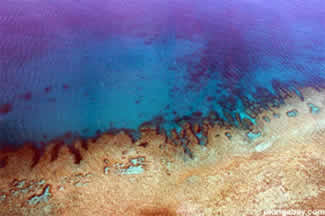
April 12, 2007 — By Reuters
JAKARTA -- A strong earthquake that struck Indonesia's Sumatra island two years ago caused one of the biggest coral die-offs ever documented, a study by scientists from two conservation groups found.
The quake itself killed nearly 1,000 people on Nias island off the western coast of Sumatra island.
The scientists, who surveyed 35 sites on the coastline, found that the earthquake had raised the island of Simeulue near Nias by up to 1.2 metres (3 ft 11 in), exposing most of the coral reefs ringing the island over about 300 km (190 miles) of sea floor, a news statement said.
The scientists were from the U.S.-based Wildlife Conservation Society and the government-backed Australian Research Council Centre of Excellence for Coral Reef Studies (ARCCoERS).
"This is a story of mass mortality on a scale rarely observed," said Dr Stuart Campbell of the Wildlife Conservation Society's Indonesia marine programme.
"In contrast to other threats like coral bleaching, none of the corals uplifted by the earthquake have survived," he said.
Campbell said, however, that some sites in Simeulue were now recovering.
"At many sites, the worst affected species are beginning to recolonise the shallow reef areas. The reefs appear to be returning to what they looked like before the earthquake, although the process may take many years," he said.
Dr Andrew Baird of ARCCoERS said the earthquake had provided a one-off chance to study such a phenomenon.
"This is a unique opportunity to document a process that occurs maybe once a century and promises to provide new insights into coral recovery processes that until now we could only explore on fossil reefs."
The team said it had documented, for the first time in Indonesian waters, extensive damage to reefs caused by the crown-of-thorns starfish, a coral predator that has inflicted huge damage on reefs in Australia and other parts of the world.
"People monitoring Indonesian coral reefs now have another threat to watch out for, and not all reef damage should be immediately attributed to human influences," said Baird.
Indonesia has some of the richest reef environments in the world, but many have also suffered from human interference.
The government has banned the use of chemicals such as cyanide and bombing to catch fish, but such practices still go on in many parts of the huge tropical nation made up of more than 17,000 islands.
Source: Reuters
Thursday, 3 May 2007
Master Guide for Underwater Digital Photography
New book shows how to make the most of digital technology, with tips for purchasing gear, selecting camera settings and taking the first dive with a digital camera.
Also included are exposure techniques; lighting tips; ideas for close-up and super-macro photography; tips for fish photography, reducing backscatter; travelling with and caring for underwater digital equipment; and tips for reef protection.
Also included are exposure techniques; lighting tips; ideas for close-up and super-macro photography; tips for fish photography, reducing backscatter; travelling with and caring for underwater digital equipment; and tips for reef protection.
Tuesday, 1 May 2007
Real Men Wear Utilikilts - News - Travel Gear Blog
As a Scotsman who is into the Outdoors, I just couldn't go past this post at http://www.travelgearblog.com
Real Men Wear Utilikilts - News - Travel Gear Blog:
"Real Men Wear Utilikilts
By Mika | Permalink | No Comments | January 4th, 2007 | Trackback
Real Men Wear UtilikiltsAt one of the many coffee shops around Portland that I swing by to grab a morning cup o’ joe, I spotted a guy sporting a Utilikilt. It’s not my first time seeing a kilt wearer, but I’d say they’re fairly rare on this side of the pond.
After chatting with our new friend, an REI employee, he agreed to let me take a picture with my new T-mobile Dash smartphone (more to come on the Dash another day) to post here on Travel Gear Blog.
If you see him running around Portland - and you might, as these kilts are donned more days than not for him, be sure to say hi. But remember, it’s culturally insensitive to ask whether it’s worn in true Scotsman style."
Real Men Wear Utilikilts - News - Travel Gear Blog:
"Real Men Wear Utilikilts
By Mika | Permalink | No Comments | January 4th, 2007 | Trackback
Real Men Wear UtilikiltsAt one of the many coffee shops around Portland that I swing by to grab a morning cup o’ joe, I spotted a guy sporting a Utilikilt. It’s not my first time seeing a kilt wearer, but I’d say they’re fairly rare on this side of the pond.
After chatting with our new friend, an REI employee, he agreed to let me take a picture with my new T-mobile Dash smartphone (more to come on the Dash another day) to post here on Travel Gear Blog.
If you see him running around Portland - and you might, as these kilts are donned more days than not for him, be sure to say hi. But remember, it’s culturally insensitive to ask whether it’s worn in true Scotsman style."
Subscribe to:
Posts (Atom)
